25–75 ft Adds $0–$1,000+ to EV Charger Costs for GTA Homes
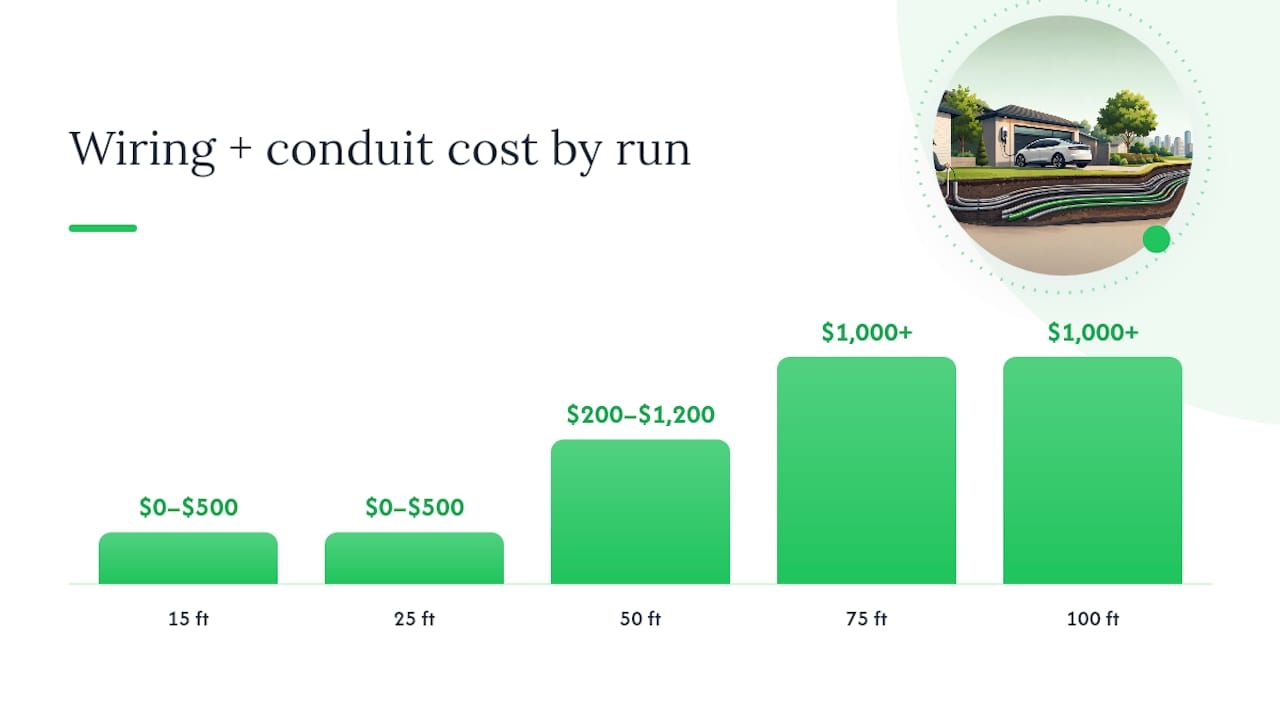
Distance from your electrical panel is often the biggest swing factor in what a Level 2 charger install actually costs. A run under 25 feet in an open basement or garage typically adds $0 to $500 in wiring and labour. A moderate 50-foot run often adds $200 to $1,200. Anything past 75 feet, especially with trenching, can add $1,000 or more, and that is before hardware or a possible panel upgrade. The breakdown, per-foot pricing, and a worked example follow below.
TL;DR:
- Wiring and labor costs for a 50-foot run typically range from $200 to $1,200, with longer or trenching routes exceeding $1,000 before hardware or upgrades.
- Trenching, exterior routing, and finishing walls significantly increase installation costs due to equipment, repairs, and material quality, especially for exterior or fully trenching routes.
- Panel upgrades are often more expensive than long wiring runs, costing between $1,500 and $3,000, especially if the existing service cannot support a 40 to 60 amp circuit.
- Accurate measurement, photos, and itemized quotes are essential to avoid unexpected expenses, particularly if trenching or panel upgrades are involved.
- Permits usually cost between $50 and $500, with inspection scope growing for trenching or exterior penetrations, but permits do not scale linearly with distance.
Table of Contents
- What drives ev charger distance cost from panel to parking spot
- Per-foot pricing: what short, moderate, and long runs actually cost
- When you need a panel upgrade and what it adds to the bill
- Permits, inspections, and where to check the rules that apply to you
- Measuring your run and estimating cost before you call anyone
- Real house layouts and what homeowners actually pay
- What a licensed installer looks for on a distance-driven job
- What to do before you accept any quote
- Get an accurate quote before distance becomes a guessing game
- Where these numbers come from
- Sources
- FAQ
What drives ev charger distance cost from panel to parking spot
The number your electrician quotes is built from a handful of moving parts, and distance touches almost every one of them. It is worth understanding what you are actually paying for before you compare quotes, because two electricians pricing the same 60-foot run can land $600 apart depending on how they handle each of these line items.
Materials versus labour. Copper wire and conduit are priced per foot, and that cost is predictable. Labour is not. An electrician running cable through an open, unfinished basement ceiling might cover 50 feet in under an hour. Fishing the same cable through finished drywall, insulation, and a couple of stud bays can take three or four times as long, because every penetration means cutting drywall, running fish tape blind, and patching afterward. EnergySage reports installed costs typically ranging from $800 to $3,000, with the distance from the panel identified as the single largest driver of where a job lands in that range.
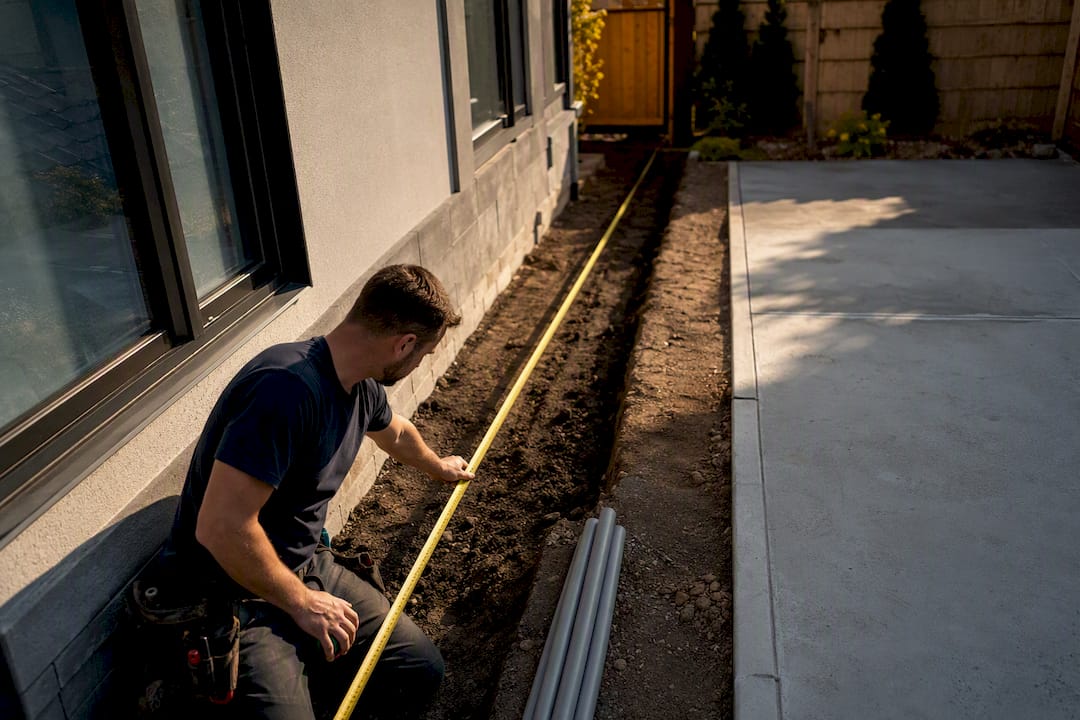
Trenching and boring. If your panel is in the basement and your car sits in a detached garage or a spot 80 feet down the driveway, someone has to get power there. That usually means trenching a channel through the lawn or driveway, laying rigid conduit rated for underground use, and pouring or patching concrete if the route crosses a slab. Trenching carries a large fixed charge on top of the per-foot rate, because renting or running equipment, cutting concrete, and restoring landscaping cost money regardless of whether the trench is 10 feet or 40.
Exterior routing. Running conduit up an exterior wall to reach a garage or carport avoids trenching, but it adds its own costs. Outdoor-rated conduit and weatherproof fittings cost more than interior materials, and any penetration through brick or stucco usually means specialty tools and sometimes a mason. Exterior work also tends to draw more scrutiny during inspection, since the wiring is exposed to weather and needs proper sealing at every entry point.
Here is roughly how those pieces stack, from cheapest to most expensive:
- Open, unfinished run (basement ceiling, garage wall): materials plus straightforward labour, minimal patching.
- Finished-wall fishing: same materials, but labour can double or triple due to drywall cuts and repair.
- Exterior wall routing: weatherproof materials, exterior penetrations, moderate labour increase.
- Trenching or concrete boring: highest fixed cost due to equipment, excavation, and restoration.
Pro Tip: Ask your electrician for a walk-through before the quote, not after. A five-minute look at your panel location and proposed mounting spot often reveals a cheaper route, like shifting the charger two feet to stay inside one wall cavity instead of crossing into another.
Per-foot pricing: what short, moderate, and long runs actually cost
Electricians rarely quote a single flat per-foot number, because the rate depends heavily on whether the run is open or finished, interior or exterior. That said, industry data gives a workable range you can use to sanity-check any quote.
ElectrifyHome’s aggregated install data shows wiring and conduit costs scaling predictably with distance, with 50 to 100 foot runs commonly adding several hundred dollars over a short, adjacent-panel install. The table below reflects typical Canadian ranges for wiring and conduit alone, excluding charger hardware, permits, or a panel upgrade.
| Distance from panel | Typical wiring + conduit cost | Notes |
|---|---|---|
| 15 ft | $0 to $500 | Open basement or garage wall, minimal labour |
| 25 ft | $0 to $500 | Standard garage install, one or two penetrations |
| 50 ft | $200 to $1,200 | May cross finished space or one exterior wall |
| 75 ft | $1,000 or more | Often involves attic routing or partial trenching |
| 100 ft | $1,000 or more | Frequently needs trenching or full exterior run |
Most electricians price a job as a base labour charge plus a per-foot rate for anything beyond a set minimum distance, often 15 to 20 feet. A typical structure looks like this:
- Base call-out and first-hour labour: covers breaker installation, mounting the charger, and basic connections, usually $300 to $600.
- Per-foot wiring and conduit: added for every foot beyond the base allowance, at the rates shown above.
- Complexity adjustments: added when the run crosses finished walls, ceilings, or exterior surfaces.
Do the math on a 60-foot run priced at typical industry rates for wiring and conduit: that is several hundred dollars in materials and incremental labour on top of the base call-out, before touching permits or a panel upgrade.
If your quote for a 50 foot run comes in at the low end of that range and your house has finished walls the whole way, ask what got left out.
When you need a panel upgrade and what it adds to the bill
Distance is not the only variable that can blow up a quote. A panel that cannot support the new circuit will trigger an upgrade regardless of how short the wiring run is, and that upgrade often costs more than even a long trenched run.
A few signs point to an upgrade being necessary:
- Your panel is rated 60 or 100 amps. Most Level 2 chargers need a dedicated 40 to 60 amp circuit, and older 60 amp services often have no headroom left.
- You have no open breaker slots. Even a modern 100 amp panel with a full breaker box may need a subpanel or breaker rearrangement.
- A load calculation shows you’re near capacity. Electricians run this calculation as part of a proper assessment, accounting for existing appliances, HVAC, and other major loads before adding a charger.
- You live in a condo or townhouse with strata rules. Shared electrical infrastructure sometimes requires approval or a different approach entirely, such as a load-managed circuit rather than a full panel replacement.
Panel upgrade costs generally run $1,500 to $3,000, and in some Toronto-area jobs with a full service upgrade to 200 amps, the number can climb higher depending on the utility connection and any required trenching to the street. That is often more than double what a long wiring run alone would cost.
If you already know you need electrical work done elsewhere in the house, a rewired kitchen circuit, a hot tub hookup, bundling that with a panel upgrade in the same visit saves on the mobilization charge electricians build into every separate service call.
Permits, inspections, and where to check the rules that apply to you
Permit requirements generally do not scale with distance the way wiring costs do. A 15-foot run and a 100 foot run both need the same electrical permit in most Canadian jurisdictions, because the permit covers the circuit and the charger, not the length of cable between them. What does change with distance is inspection scope: longer runs with trenching or exterior penetrations sometimes draw a closer look at weatherproofing and burial depth.
A few things worth knowing before you sign a quote:
- Check your provincial or territorial safety authority. Technical Safety BC outlines installation permit requirements for EV chargers, and every province has an equivalent body, whether that is the Electrical Safety Authority in Ontario or an analogous agency elsewhere.
- Municipal permit fees vary widely. Fees commonly range from $50 to $500 or more depending on your municipality, and some jurisdictions fold the electrical permit into a broader building permit.
- A licensed electrician typically files the permit for you. This is standard practice, not an upsell, and it means you are not the one tracking down inspection windows.
- Confirm the ESA permit is included in your quote, not billed separately after the fact.
Skipping the permit step to save time is one of the more common mistakes homeowners make, and it can complicate insurance claims or resale down the line.
Measuring your run and estimating cost before you call anyone
You do not need an electrician on site to get a reasonable first estimate. A tape measure, your phone camera, and ten minutes will get you most of the way there.
- Measure panel to mounting point in a straight line, following the likely cable path rather than a direct diagonal, since wiring has to follow walls, ceilings, or ground, not the shortest geometric distance.
- Note how much of the route is open versus finished. Unfinished basement or garage walls are cheap to work with; drywall, insulation, and ceilings add labour.
- Measure any exterior or trench section separately, since that portion prices differently than interior runs.
- Photograph the panel, the proposed mounting wall, and the full route. Clear photos let an electrician give a much tighter estimate before ever visiting, saving you a wasted site visit if the numbers are far off.
A cost calculator like Evchargerinstallationtoronto’s estimator works from the same inputs a human quote would: charger hardware price, base labour, per-foot wiring and conduit, a permit fee allowance, and a panel upgrade allowance if one applies.
Here is how two common scenarios compare, wiring and conduit only, before hardware, permits, or an upgrade:
| Scenario | Distance | Wiring + conduit estimate | Assumptions |
|---|---|---|---|
| Short, open run | 25 ft | $0 to $500 | Basement panel, open garage wall, no finished surfaces |
| Long, mixed run | 75 ft | $1,000 or more | Crosses one finished wall and a short attic section |
The gap between those two, roughly $550 to $1,000, is purely a function of distance and route complexity. Add a panel upgrade to either scenario and the total changes far more dramatically than the wiring difference alone.
Real house layouts and what homeowners actually pay
Three layouts cover most Greater Toronto Area homes, and matching your house to one of them gives you a realistic starting number before any quote arrives.
- Best case: panel adjacent to the garage. Minimal wiring, no finished walls to cross, existing panel capacity. Installers typically finish in two to three hours, and total installed cost, hardware included, often lands near the lower end of the $1,000 to $3,000 range FLO cites for typical installs.
- Typical case: 25 to 50 foot run with attic routing. Common in homes where the panel sits in a finished basement and the garage is on the opposite side of the house. Expect four to six hours on site, with patching and paint touch-up sometimes needed the next day.
- Complex case: detached garage or opposite side of house. Often involves trenching, exterior conduit, and occasionally a panel upgrade if the existing service is already near capacity. These jobs can run a full day or spill into a second visit, and installers usually flag this scenario during a phone consultation before ever quoting a number. For a detached structure, review what outdoor and detached-garage installs typically cost before assuming the worst case applies to you.
The best-case and complex-case totals can differ by $2,000 or more once trenching and a panel upgrade both enter the picture, which is exactly why an accurate distance measurement matters more than almost any other input in your quote.
What a licensed installer looks for on a distance-driven job
Every licensed electrician walking into a distance-heavy job runs the same mental checklist: where is the panel, where does the car park, and what is in between. Licensed electricians handle installations across the Greater Toronto Area, with pricing starting from a set amount and same-week booking availability for many jobs.
A few things the company handles as standard, not as an add-on:
- Permit filing and final inspection, at no extra charge, so homeowners are not chasing paperwork mid-project.
- Rebate application support, including guidance on the federal EV incentive worth up to $5,000 for eligible new EV purchases.
- Same-week booking in most cases, with many installs completed in a few hours once the crew is on site.
On the technical side, installers generally recommend mounting the charger on the wall closest to the panel wherever the garage layout allows it, since a two or three foot shift in mounting position can sometimes avoid a full attic route or a finished-wall crossing. When a home’s panel genuinely cannot support a new 40 to 60 amp circuit, an EVEMS load management system is often evaluated as an alternative to a full panel upgrade, staggering charging load rather than replacing the service entirely.
Pro Tip: If your quote mentions a panel upgrade, ask specifically whether an EVEMS or similar load-management option was considered first. It is not always cheaper, but it is worth ruling out before agreeing to the larger expense.
What to do before you accept any quote
Distance-driven costs surprise a lot of homeowners because nobody mentioned trenching or a panel upgrade until the quote landed in their inbox. Avoid that by doing three things in order.
Measure the actual route yourself first, following walls and ceilings rather than a straight line, and note where it crosses finished drywall or goes outdoors. Photograph the panel and the proposed mounting wall so any electrician you call can give you a tighter number before a site visit. Then get at least one in-person quote and ask for an itemized breakdown separating wiring, labour, permits, and any panel upgrade, since a bundled number hides which line item is actually driving the cost. Finally, check what municipal or utility rebates apply in your area before signing anything, and confirm the installer is handling the permit filing rather than leaving that step to you.
— Hafiz
Get an accurate quote before distance becomes a guessing game
The gap between a $1,800 install and a $4,000 one usually comes down to a handful of decisions made before any work starts, and that is exactly where Evchargerinstallationtoronto’s ESA-licensed crews earn their keep. Instead of a generic phone quote based on square footage, their team assesses your actual panel-to-parking-spot distance, checks whether load management can skip a panel upgrade entirely, and files every permit and rebate application at no extra charge.
Pricing starts from a set amount, with same-week booking available across the Greater Toronto Area, and many jobs complete within a few hours once the crew arrives. If you drive an EV from a specific automaker, dedicated installation pages cover Ford, Volkswagen, and BMW owners with model-specific charging considerations. Start with the free cost calculator to plug in your measured distance for an instant ballpark, then book a site visit for a firm, itemized quote before your installation date fills up.
Where these numbers come from
The cost ranges and permit guidance in this article draw on a handful of sources worth checking directly if you want to verify anything against your own address and municipality.
- EnergySage’s EV charger installation cost breakdown for distance-driven cost bands and installer interviews.
- ElectrifyHome’s aggregated real install data for per-foot wiring examples and permit fee ranges.
- Technical Safety BC’s permit guidance for installation permit requirements.
- FLO’s homeowner cost guide for typical installed cost ranges.
Check your municipal permit office and local utility rebate page directly, since fees and incentive programs change more often than national cost guides get updated.
Sources
- How much does an EV charger installation cost? | EnergySage
- EV Charger Installation Cost 2026: $900 - $1,500 (Real Data) | ElectrifyHome
- Electric vehicle chargers – installation permits | Technical Safety BC
- The real cost of installing a home EV charger | FLO
FAQ
How much does it cost to charge an electric car to 100%?
Charging cost depends on your electricity rate and battery size, but at typical Ontario residential rates, a full charge for most EVs runs roughly $10 to $20, far less than the equivalent tank of gasoline.
How much does it cost to drive an electric car 100 km?
Most EVs use about 15 to 20 kWh per 100 km, which at typical residential electricity rates works out to somewhere in the $2 to $4 range for that distance, well below the cost of gasoline for the same trip.
How much does it cost to use a public EV charging station in Canada?
Public Level 2 stations often charge by time or a flat session fee, while DC fast chargers typically bill per kWh or per minute at a noticeably higher rate than home charging, which is one reason most EV owners prioritize installing a charger at home.
What is the 80/20 rule for EV charging?
The 80/20 rule refers to keeping a battery’s daily charge between roughly 20% and 80% to reduce long-term battery degradation, rather than routinely charging to 100% or letting it run near empty.
Does the distance from my panel affect whether I need a permit?
Permit requirements generally stay the same regardless of distance, but longer runs involving trenching or exterior conduit can mean closer inspection scrutiny on weatherproofing and burial depth.
Is it cheaper to install a Level 1 charger instead of Level 2 to avoid distance costs?
A Level 1 charger uses a standard outlet and avoids new wiring in some cases, but it charges far more slowly and does not eliminate distance costs if your electrical panel still needs a dedicated circuit run to the parking spot.
Recommended
Get Your Free Installation Quote
Free assessment · ESA permit included · Same-week availability across the GTA