Toronto Homeowners: How ESA Inspects Your EV Charger and What Fixes Pass
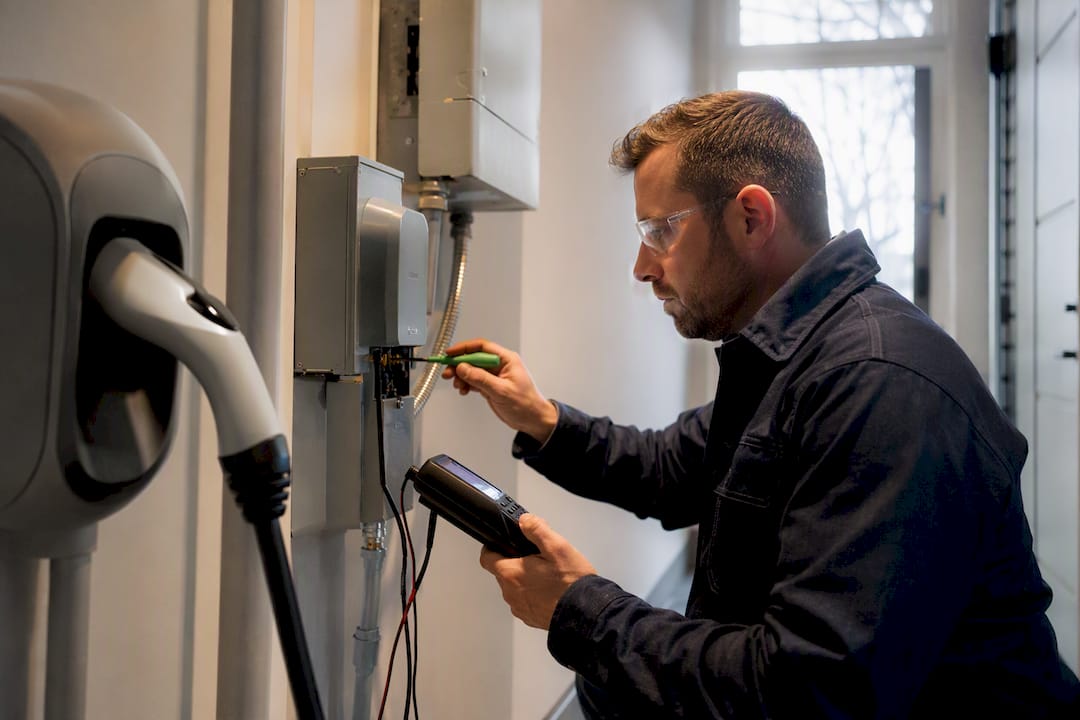
Yes, every residential EV charger installation in Toronto requires an ESA permit and a post-install inspection, and passing it earns you a Certificate of Acceptance. That certificate is your legal proof the wiring is safe. Your only job right now is simple: hire an ESA-licensed contractor who files the permit and books the inspection for you.
TL;DR:
- The inspection verifies that the circuit is dedicated, correctly sized, and properly grounded, especially since EV chargers draw power continuously longer than household appliances.
- A common reason for failing inspections is an older, near-capacity panel, often leading to a necessary panel upgrade before passing.
- The permit process involves a licensed electrician filing paperwork, coordinating with Toronto Hydro when needed, and providing a Certificate of Acceptance after passing inspection.
- Fixing inspection failures typically involves the electrician correcting wiring or grounding issues and requesting reinspection within days, not weeks.
- Hiring a licensed contractor ensures permit filing, inspection management, and safe installation, reducing the risk of failed inspections and legal issues later.
Table of Contents
- What does an EV charger inspection in Toronto check?
- How do you prepare your home before the inspection?
- How long does the process take and what does it cost?
- What happens if the inspection fails?
- Why licensed installers cut your inspection risk
- How Evchargerinstallationtoronto handles your permit and inspection
- Where to verify the details yourself
- Sources
What does an EV charger inspection in Toronto check?
An Electrical Safety Authority inspection exists to confirm one thing: that a continuous electrical load, running for hours at a stretch, won’t overheat a wire, a breaker, or a panel bus bar. That’s the real purpose behind the paperwork. An EV charger pulls power steadily for far longer than a dryer or a stove, which is exactly why inspectors treat this circuit differently from a standard renovation add.
Here’s what an inspector actually verifies on site:
- The circuit is dedicated to the charger and sized correctly for a continuous load under the Ontario Electrical Safety Code.
- Breaker size and wire gauge match the charger’s amperage draw, with terminations torqued to spec.
- Grounding and bonding are complete and continuous back to the panel.
- The charger itself is mounted and wired exactly to the manufacturer’s installation instructions.
- Required labelling and warning stickers are in place at the panel and the charger.
- The panel itself is in acceptable condition. No hot or discoloured terminations, no overloaded bus, no undersized feeder.
That last point trips up more homeowners than any other. Pro Tip: An older 100-amp panel that’s already near capacity is one of the most common reasons an EV charger install turns into a panel upgrade conversation halfway through the job.
Once everything checks out, the inspector documents the result and the ESA issues a Certificate of Acceptance. Keep that certificate somewhere permanent. Insurers, home inspectors, and future buyers will ask for it, and without it there’s no official record the electrical work was ever done to code.
How do you prepare your home before the inspection?
Preparation is mostly about verifying who you’ve hired and what they’ve promised, not about touching any wiring yourself. Before install day, run through these checks:
- Confirm your contractor’s ECRA/ESA licence number and that a Master Electrician is attached to the job.
- Verify the contractor is the one pulling the permit, not you, and not a subcontractor working off someone else’s licence.
- Ask whether a pre-install panel scan makes sense for your home, and whether that fee gets credited toward the installation if you proceed.
- Confirm whether your charger will be plug-in or hardwired, and ask why your electrician recommends one over the other for your setup.
- Ask directly whether Toronto Hydro coordination or an Offer to Connect will be needed, which usually only comes up when a service upgrade is involved.
- Get the permit number, an expected inspection window, and a clear commitment that you’ll receive the Certificate of Acceptance once it passes.
A thermal panel scan isn’t mandatory, but it’s a smart diagnostic step. It uses infrared imaging to catch hot terminations or capacity issues before they become a failed inspection. It doesn’t replace the ESA’s final inspection. Nothing does. But it can save you a second visit and a second wait.
Pro Tip: If your electrician offers a pre-scan, ask specifically whether the fee rolls into the install cost if you book with them. Reputable installers structure it that way so the diagnostic doesn’t feel like a separate upsell.
How long does the process take and what does it cost?
A straightforward Level 2 install typically wraps up in a single day, but the inspection itself doesn’t happen on install day. Your electrician files the permit, the work gets done, and then you wait for the ESA to schedule the inspection. That wait tends to stretch longer when panel upgrades or Toronto Hydro coordination are part of the job, since those add extra steps to the sequence.
Cost ranges vary by scope:
- A straightforward Level 2 charger install on a panel with available capacity sits at the lower end of the cost range.
- A 200A panel upgrade or new sub-panel adds meaningfully more, since it involves more material and more labour.
- A pre-install thermal scan is a smaller add-on fee, often credited back if you book the full install.
- The ESA permit fee itself is a modest flat cost bundled into your contractor’s quote, covering the permit filing and inspection documentation together.
If your home’s electrical service can’t support the added load, or if your street infrastructure needs a look, Toronto Hydro’s preliminary consultation process comes into play. That step assesses connection complexity and available capacity, and it adds both time and cost that a simple install would never touch. Ask your contractor upfront whether your address is likely to trigger this, especially if you live in an older home or a building with shared electrical infrastructure. A panel upgrade quote should spell out whether Toronto Hydro involvement is expected.
What happens if the inspection fails?
Failures are almost always fixable, and they’re almost never the homeowner’s problem to solve directly. The most common causes are mechanical, not mysterious:
- Wrong wire gauge or an oversized breaker for the circuit.
- Loose or improperly torqued terminations.
- Missing or incomplete grounding and bonding.
- A charger installed in a way that doesn’t match the manufacturer’s own instructions.
Correcting these is the contractor’s responsibility under the permit they filed. A licensed electrician fixes the flagged items, documents exactly what changed, and requests reinspection through the ESA. Most straightforward fixes, like a swapped breaker or a re-torqued connection, get resolved and reinspected within days rather than weeks. What you shouldn’t do is skip reinspection or accept a verbal “it’s fine now” from your contractor. Without updated paperwork, you’re back to having no legal record the work is safe, which matters enormously at resale and with your home insurer if a claim ever touches your electrical system. If a contractor refuses to correct a permit-related failure, you can escalate directly to the ESA, since the permit was filed under their licence, not yours.
Why licensed installers cut your inspection risk
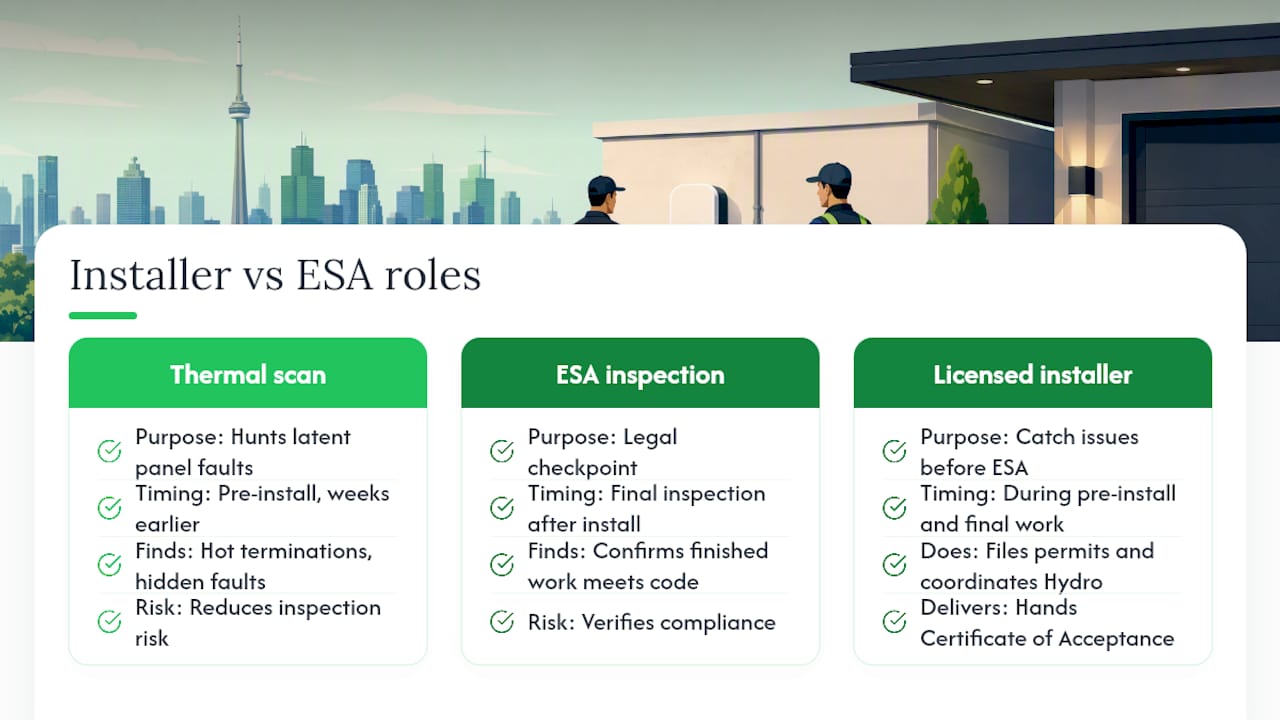
Homeowners often assume the inspection is where risk gets caught. In practice, the risk gets built in weeks earlier, at the panel assessment stage, and a good installer’s job is catching it before the ESA ever shows up. A pre-install thermal scan and the mandatory final inspection do different jobs. The scan hunts for latent panel faults, like a hot termination nobody’s noticed yet. The ESA inspection is the legal checkpoint that confirms the finished work meets code.
Licensed contractors carry the permit obligation themselves. They file the paperwork, coordinate Toronto Hydro when a service upgrade is genuinely needed, and hand you the Certificate of Acceptance once it’s issued. That’s not a courtesy. It’s the entire point of hiring someone licensed instead of piecing the job together yourself. Before you sign anything, ask for the contractor’s ECRA/ESA number and confirm in writing that permit filing and inspection coordination are part of the quote, not an extra line item you’ll be chasing later.
— Hafiz
How Evchargerinstallationtoronto handles your permit and inspection
A direct alternative to piecing this project together yourself is to hire an ESA-licensed electrician who pulls the permit, coordinates with Toronto Hydro if your service needs it, and manages the inspection from start to finish, typically without adding a separate fee for the paperwork.
Every installation includes a Master Electrician on the job, permit filing handled on your behalf, and the Certificate of Acceptance delivered once your inspection passes. If your panel is older or you’re unsure whether you’ll need an upgrade, ask about the EVEMS smart load management option, which can sometimes avoid a costly panel upgrade entirely. Evchargerinstallationtoronto also manages rebate paperwork worth up to $5,000 on new EV purchases and offers same-week booking for homeowners who don’t want to wait weeks for a quote. Run the free cost calculator to see where your home lands, or check the ESA permit page to see exactly what’s included before you book your estimate.
Where to verify the details yourself
If you want to check any of this against the primary sources rather than take a contractor’s word for it, these are the places to start:
- Toronto Hydro’s on-street EV charging program page gives useful context on how the utility approaches charger safety citywide.
- NIST’s technical guidance for retail EV fueling systems offers a deeper technical look at the safety and testing standards behind charging equipment generally.
Sources
- Toronto Hydro — Electric vehicle preliminary consultation information request (EVPCIR) form
- NIST — Guidelines and test criteria for retail EV fueling systems (EVFS)
Recommended
Get Your Free Installation Quote
Free assessment · ESA permit included · Same-week availability across the GTA