Homeowners: Pick the Right EV Charger IP Rating; Installer Checklist
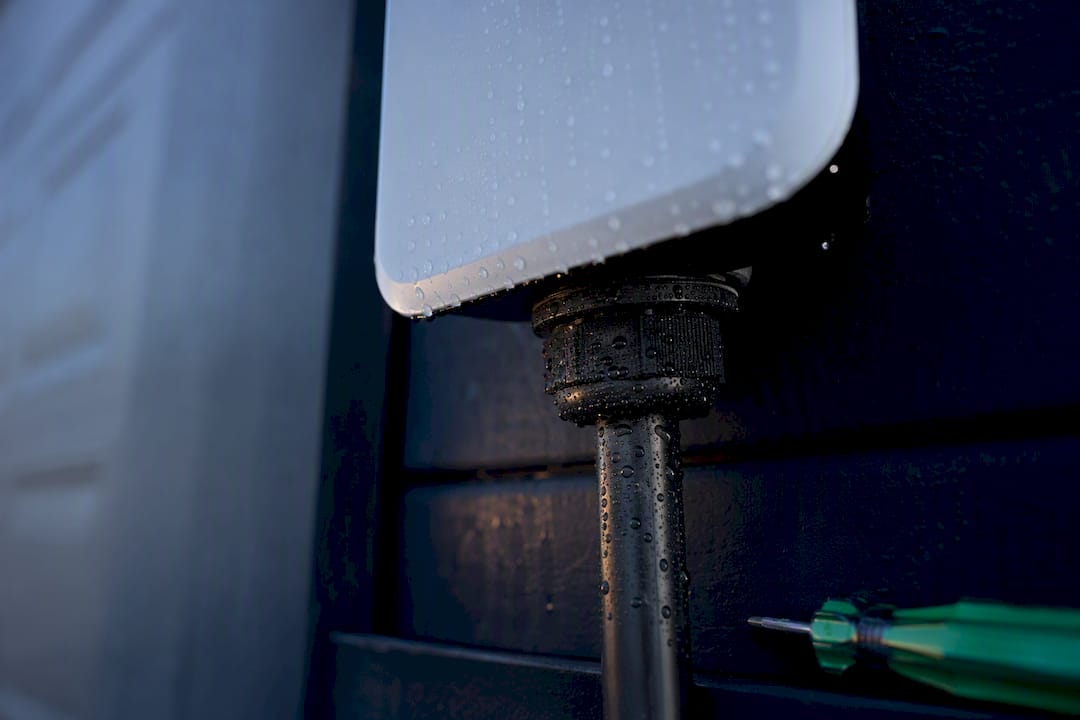
An IP rating tells you how well an EV charger’s enclosure resists dust and water, using two digits defined under IEC 60529. For a sheltered garage, IP44 or IP54 usually covers you. For a carport or exposed driveway, look for IP55 or IP65. Before you buy or book an install, check the datasheet for the IP number and confirm the unit carries UL or ETL certification, then let a licensed electrician handle the mounting.
TL;DR:
- An IP55 or IP65 rating is recommended for outdoor chargers exposed to wind-driven rain, salt air, or high foot traffic, while IP44 suffices for sheltered garages.
- Always verify a charger’s IP and NRTL certification through official datasheets and labels rather than marketing claims before installation.
- Proper sealing of conduit entries and ensuring the connector holster remains dry are critical factors that influence a charger’s durability beyond its IP rating.
- For high-risk environments like coastal or high-traffic sites, both IP65 and impact ratings such as IK08 or IK10 provide added protection against corrosion and physical damage.
- An experienced, licensed electrician must handle the installation to ensure waterproofing, drainage, and sealing meet safety standards, not just the IP rating on paper.
Table of Contents
- What does an EV charger IP rating actually mean?
- Common IP ratings for EV chargers and what they mean in practice
- IP vs NEMA vs IK: what to check for North American installs
- How to choose the right rating for your installation
- Cables, connectors, and what your IP rating doesn’t cover
- Where to verify a charger’s IP rating before you buy
- What an electrician actually checks during installation
- Book your EV charger installation with confidence
- An installer’s take on IP ratings
- Sources
- FAQ
What does an EV charger IP rating actually mean?
The IP system uses two digits, and each one answers a different question. The first digit, ranging from 0 to 6, covers protection against solid objects. The second, ranging from 0 to 9 (with a “K” variant for high-pressure jets), covers liquids.
Here’s how the solids scale breaks down in practical terms:
- 0 to 1: No protection, or protection only from a large surface like the back of a hand.
- 2 to 3: Blocks fingers and tools thicker than 2.5 millimetres.
- 4: Stops wires and small tools over 1 millimetre, including most insects.
- 5 to 6: Dust-protected to fully dust-tight, the range you want for any charger sitting outdoors.
The liquids scale runs from vertically dripping water (rating 1) through splashing and spraying water (3 and 4) up to powerful jets (5 and 6), temporary immersion (7), and continuous immersion (8). A rating of 9K, which shows up on some newer public charger datasheets, means the enclosure survives high-pressure, high-temperature washdowns, the kind used to clean parking structures or transit depots.
When you’re scanning a spec sheet, the IP code usually sits near the electrical ratings, often printed right on the charger’s rating label too. Look for a format like “IP65” or “IP54,” and treat anything without a listed IP code as a red flag worth asking about directly.
Common IP ratings for EV chargers and what they mean in practice
Manufacturers cluster around a handful of ratings, and each maps to a fairly specific installation scenario.
- IP44 or IP54: Built for indoor or fully sheltered spots, like an attached garage. These resist dust and splashing water but aren’t meant to face driving rain or standing water. Industry guides on EV charger IP ratings consistently place this tier at the “sheltered use only” end.
- IP55 or IP65: The standard for unsheltered residential driveways and a large share of public charging stations. These handle dust ingress and low-pressure water jets from any direction, which covers wind-driven rain and road spray. Phihong’s guidance on outdoor DC fast charger ratings points to IP55/IP65 as the practical baseline for anything sitting outside full-time.
- IP66, IP67, IP68: Built for heavy jets, temporary immersion, or continuous submersion. These show up on some commercial or coastal installations, but they’re rarely necessary for a wall-mounted home charger under a carport roof.
Chasing an IP68 rating for a garage-mounted charger that never sees rain is money spent on protection you’ll never use. Match the rating to the actual exposure, not to the biggest number on the shelf.
IP vs NEMA vs IK: what to check for North American installs
IP ratings come from IEC 60529, a European-rooted standard. NEMA, the North American equivalent maintained by electrical manufacturers here, addresses similar ground but adds specifics around ice formation, corrosion resistance, and enclosure construction that IP alone doesn’t test for.
- NEMA 3R covers outdoor use with protection from rain, sleet, and some ice, roughly comparable to IP54/IP55 territory.
- NEMA 4 adds protection from splashing water and hose-directed water, closer to an IP65/IP66 equivalent.
- IK ratings measure impact resistance on a scale up to IK10, which matters far more for public or high-traffic sites than for a home driveway. Phihong’s comparison of IP, NEMA, and IK notes that IP alone doesn’t tell the full story for North American outdoor sites.
When you’re buying equipment for installation here, ask for the IP number, the NEMA equivalent, and confirmation of NRTL listing (UL or ETL) together. That combination gives you a fuller read on how the unit performs than any single rating on its own.
How to choose the right rating for your installation
The right IP rating depends entirely on where the charger will live, not on what sounds impressive in a spec sheet.
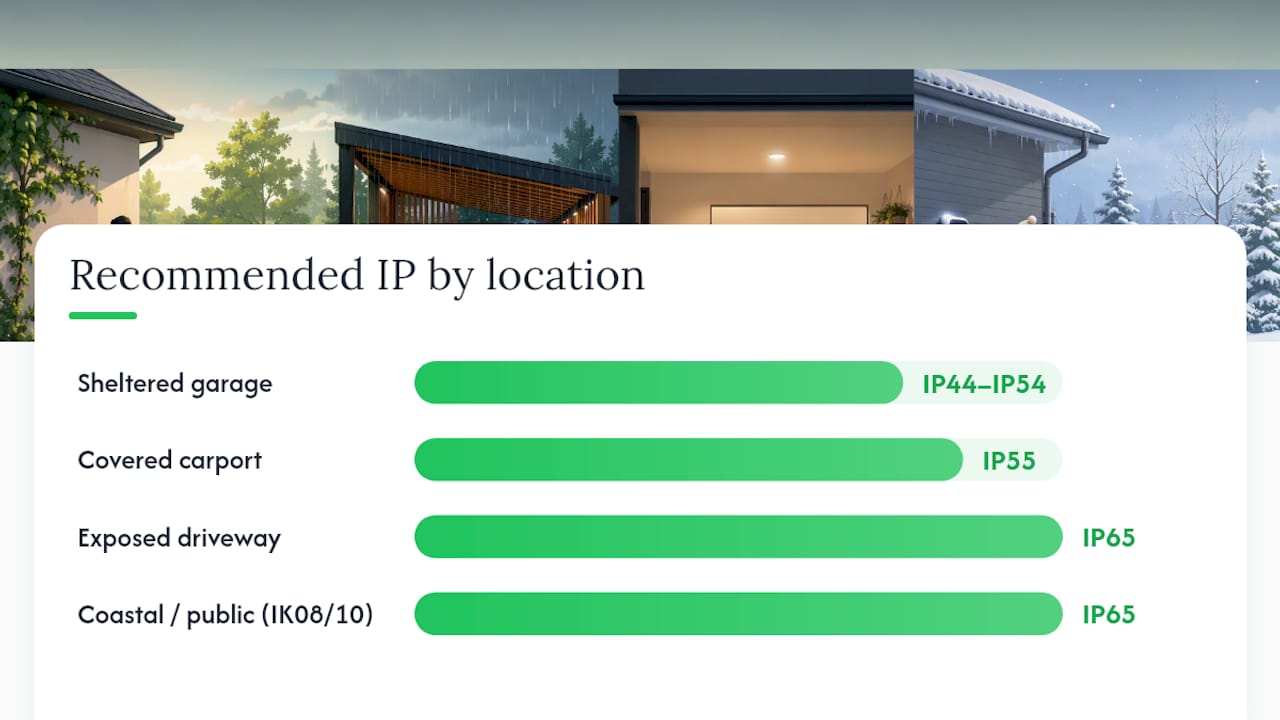
For a fully enclosed garage with no exposure to weather, IP44 is typically sufficient, though IP54 gives you margin against dust and the odd wet vehicle dripping nearby. A covered carport with open sides needs more: IP55 as the practical floor, since wind can drive rain sideways even under a roof. A fully exposed driveway or a spot near a coastline, where salt air accelerates corrosion, calls for IP65 as the sensible baseline. Public or fast-charging sites should carry IP65 or better, plus an IK08 or IK10 rating if the location sees foot traffic, shopping carts, or potential vandalism.
A few site conditions push the decision higher regardless of general rules: proximity to a driveway where you regularly hose down vehicles, coastal salt exposure, and any location where a hose or pressure washer might hit the unit directly.
Pro Tip: Before you call an installer, snap a photo of your intended mounting spot at different times of day. If you can see direct rain exposure or standing water pooling nearby in any shot, budget for IP65 rather than IP54, even if the spot looks sheltered on a sunny afternoon.
Copy this shortlist before you shop or call an installer:
- Sheltered garage: IP44 minimum, IP54 preferred.
- Covered carport: IP55 minimum.
- Exposed driveway: IP65 minimum.
- Coastal or high-traffic public site: IP65 plus IK08/IK10.
Cables, connectors, and what your IP rating doesn’t cover
The enclosure’s IP rating and the connector’s IP rating are often two different numbers, and datasheets don’t always make that obvious. A charger body rated IP65 can still pair with a connector or holster that carries a lower rating, so check both specs before assuming the whole assembly performs the same.
Cold weather introduces its own problems that no IP number addresses. Consumer Reports notes that charging cables can stiffen and become harder to handle in extreme cold, and seals around connector interfaces are often the first weak point when ice forms at the mating surface.
- Keep the dust cap closed on the connector holster whenever the charger isn’t in use.
- Inspect rubber seals and boots once a year for cracking or shrinkage.
- Replace any cable showing visible stiffness, cracking, or exposed strands rather than waiting for it to fail.
Pro Tip: Park so the connector faces away from prevailing wind and rain where your driveway layout allows it. It’s a small habit that meaningfully cuts ice buildup at the connector seal through a Canadian winter.
Where to verify a charger’s IP rating before you buy
Don’t take a marketing page’s word for the IP number. Confirm it through these three checks.
- Pull the manufacturer’s datasheet or spec sheet, where the IP code appears alongside electrical specs, and cross-check it against the label printed on the physical unit.
- Look for a UL or ETL mark, both nationally recognized testing laboratory (NRTL) designations, and ask the vendor for the test report if the listing isn’t clear on the packaging or product page. Standards bodies like SAE’s J2953/4 test and reporting procedures exist precisely so buyers can request consistent documentation instead of relying on vendor claims alone.
- If you’re still unsure, request a certificate of conformance directly from the vendor and have your installer confirm the rating suits your specific mounting location.
ENERGY STAR’s EVSE specification also standardizes how charger categories get tested and reported, which makes comparing two units’ documentation far easier than comparing marketing copy.
What an electrician actually checks during installation
A qualified installer isn’t just mounting a box on a wall. On-site, we check the mounting surface for proper drainage away from the unit, confirm conduit entry points are sealed so water can’t track in along the wiring, and route cable with enough slack to handle contraction in cold temperatures without straining the connector seal.
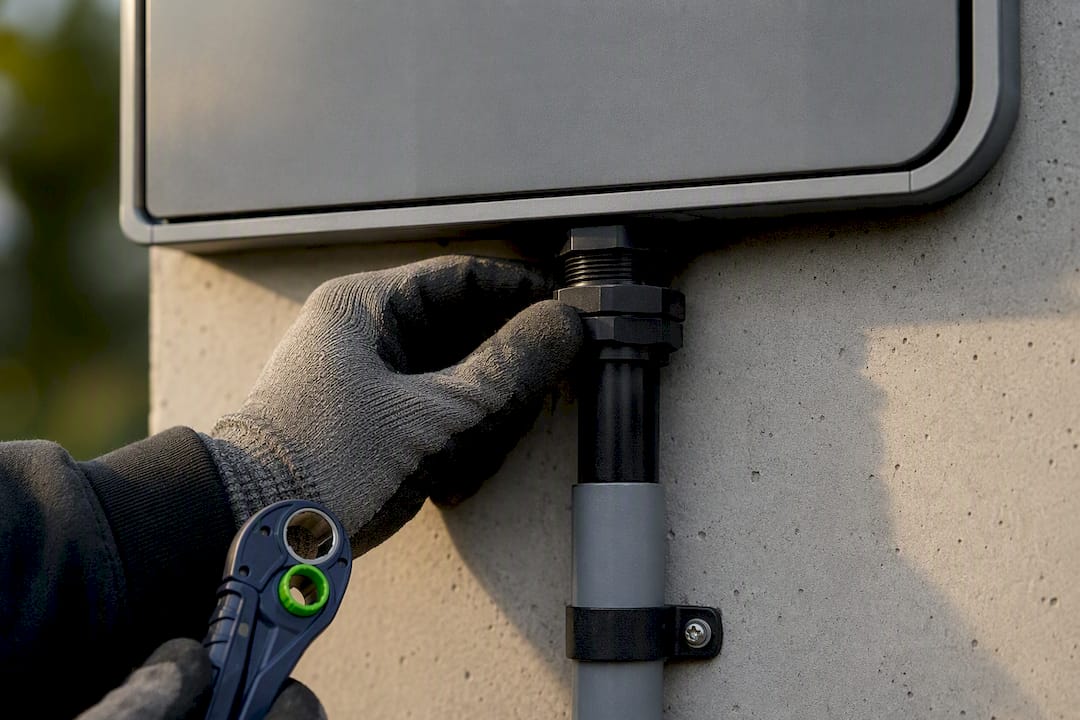
Permits and NRTL verification get bundled into the same visit, along with rebate paperwork where it applies, because these tasks all depend on confirming the same equipment details. Installer checklists for wet-weather charging consistently flag mounting drainage and conduit sealing as the two most commonly missed details in DIY installs. A typical Level 2 install runs a few hours from start to finish when a licensed electrician handles the permit and inspection process alongside the physical work, rather than as a separate step.
Book your EV charger installation with confidence
Getting the IP rating right on paper means nothing if the installation itself introduces a leak point at the conduit entry or a poorly sealed connector holster. That’s the gap a licensed electrician service closes for homeowners across the Greater Toronto Area. Every job is handled by licensed electricians who confirm the equipment’s rating matches the mounting location, then manage permits and inspections.
Pricing starts at $1,800 for a Level 2 Home Charger Installation, with panel upgrade bundles and Tesla-certified work available depending on your home’s electrical service. Some installers may provide rebate application support and offer timely booking.
An installer’s take on IP ratings
Most of the advice floating around about EV charger IP ratings treats the number like a purity score, where bigger always wins. That’s backwards. An IP68-rated charger mounted in a bone-dry attached garage isn’t protecting you from anything; it’s just a bigger number on a spec sheet that cost more to manufacture and probably more to buy.
What actually determines whether your charger survives ten Canadian winters isn’t the digit after “IP.” It’s whether the installer sealed the conduit entry properly, whether the connector holster keeps the cable end dry when you’re not using it, and whether someone checked the mounting spot for water pooling before drilling the first hole. The rating on the datasheet is a starting filter, not a guarantee.
If you take one thing from this: match the rating to your actual site conditions, verify it through the datasheet and an NRTL mark rather than a sales page, and spend your attention on installation quality. That’s where chargers actually fail.
— Hafiz
Sources
- How to choose the best home wall charger for your electric vehicle | Consumer Reports
- IP55, NEMA 3R, and IK ratings for outdoor DC fast chargers | Phihong
- ENERGY STAR EVSE Version 1.2 specification
FAQ
Is an EV charger waterproof?
No. EV chargers are weather resistant, not waterproof. Consumer Reports confirms most home units rely on IP or NEMA ratings that resist rain and splashing but aren’t designed for submersion.
Is it okay if an EV charger gets wet?
Light rain or splashing is fine for a charger rated IP54 or higher, since that’s exactly what those ratings are built to handle. Standing water pooling around the base or direct submersion is not something any typical home charger is rated for.
Are EV chargers safe to use in the rain?
Yes, when the unit carries an appropriate IP or NEMA rating for outdoor use and a licensed electrician installed it with proper drainage and sealed conduit entries. The connector and cable stay dry-rated too, provided seals and dust caps are in good condition.
What is the IP rating on a Tesla charger?
Tesla’s Wall Connector is rated for outdoor installation and built to handle typical rain and splash exposure, consistent with the IP55/IP65 range common across outdoor residential chargers. Always confirm the exact figure on the current datasheet before installation, since specs can change between hardware versions.
Do I need a higher IP rating for a coastal or high-traffic location?
Yes. Salt air accelerates corrosion, so coastal installations should aim for IP65 as a baseline, and high-traffic public sites benefit from adding an IK08 or IK10 impact rating on top of that.
Recommended
Get Your Free Installation Quote
Free assessment · ESA permit included · Same-week availability across the GTA